Introduction
Marine biology is the scientific study of organisms in the ocean and other brackish or marine bodies of water. Given that oceans cover more than 70% of our planet, this discipline is not merely a branch of biology; it is a critical science that determines the ecological balance, climate stability, and biological survival of the Earth.
From the microscopic phytoplankton drifting near the sunlit surface to the massive cetaceans migrating across oceans, marine biology examines how life adapts to the unique physical and chemical properties of the marine environment.
The Core Pillars of Marine Biology
To truly understand marine science, researchers divide the ocean's vast complexity into several specialized areas of study:
1. Marine Ecology and Ecosystems
Marine life does not exist in isolation. Marine biologists study how organisms interact with each other and their environment. These interactions form distinct ecosystems, each with its own challenges:
Coral Reefs: Often called the "rainforests of the sea," these hyper-diverse habitats support a quarter of all marine species despite covering less than 0.1% of the ocean floor.
The Pelagic Zone: The open ocean, where migratory fish, sharks, and marine mammals navigate vast blue deserts.
The Benthic Zone: The ocean floor, ranging from shallow seagrass meadows to the extreme pressure of abyssal plains.
2. Marine Ichthyology and Taxonomy
Classification and identification are fundamental to conservation. Marine taxonomy organizes life into precise evolutionary lineages. Understanding the specific biology of keystone species—such as the predatory roles of sharks or the complex lifecycles of decapod crustaceans like the European Spiny Lobster (Palinurus elephas)—is vital for managing biodiversity.
3. Biological Oceanography
This sub-field looks at the macro-level interactions between marine biology and ocean physics, chemistry, and geology. It explains how ocean currents distribute nutrients, how temperature changes trigger massive plankton blooms, and how the oceans act as the planet's primary carbon sink.
The Digital Revolution in Marine Science
The days of relying solely on physical specimen jars and static textbook descriptions are over. In 2026, the modern approach to marine biology is heavily integrated with technology.
The internet has democratized ocean literacy. Today, advanced marine biology websites operate as high-performance hubs where computational power meets fieldwork. The integration of specialized digital databases and intelligent information retrieval allows researchers, divers, and students to access taxonomic data instantly from anywhere in the world.
Furthermore, regional specialization—such as detailed digital atlases dedicated entirely to the complex biodiversity of the Mediterranean Sea—provides targeted, high-fidelity data that global, generalized databases often overlook.
Why Marine Biology Matters: The Challenges of 2026
The study of marine biology is inextricably linked to global survival. The oceans face unprecedented anthropogenic pressures, making scientific intervention more urgent than ever:
Climate Change and Acidification: As the oceans absorb excess carbon dioxide, the water's pH drops, making it difficult for calcifying organisms (like corals, mollusks, and certain plankton) to build their shells.
Biodiversity Loss: Overfishing and habitat destruction disrupt marine food webs, threatening food security for billions of humans.
Invasive Species: Global shipping and warming waters allow species to migrate into non-native habitats—a phenomenon heavily observed in the Mediterranean—altering local ecosystems permanently.
Conclusion: Connecting Humanity to the Ocean
Marine biology is no longer a science confined to secluded laboratories. It is a collaborative, global effort. True ocean literacy means making scientific insights accessible to everyone, ensuring that the technology used to document the sea is as adaptive and resilient as the life it seeks to protect.
Discover more comprehensive data, species profiles, and regional ecological tracking at https://www.vitamarinaweb.com/en/ — your gateway to modern marine science.
What is Marine Biology? The Science, Technology, and Future of Ocean Life
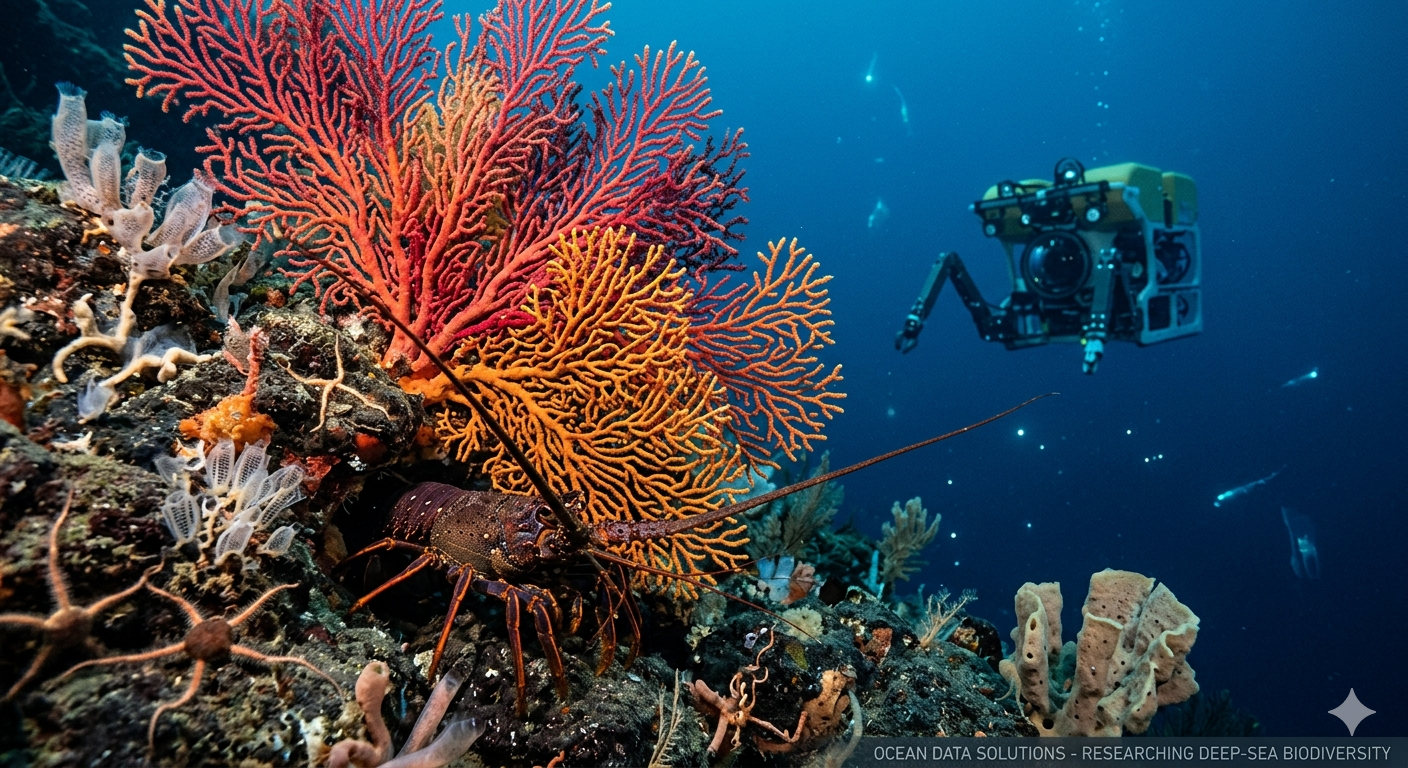 "Deep-sea benthic research station featuring Paramuricea coral fan, a decapod crustacean habitat, and a monitoring ROV in the background - exploring ocean biodiversity."