The Challenge of Subtropicalization in the Mediterranean
The Mediterranean Sea, while representing less than 1% of the world’s ocean surface, hosts over 17,000 marine species. In 2026, this biodiversity is undergoing a rapid transformation due to climate shifts and the phenomenon known as tropicalization. Traditional printed field guides and static academic databases can no longer keep pace with these ecological changes. Marine biologists and conservationists require a real-time, dynamic approach to taxonomy.
The Evolution of Digital Fish Atlases
Historically, marine biology websites provided static lists of species, often lacking regional context. A modern Mediterranean Fish Atlas must operate differently. It needs to bridge the gap between classic morphological taxonomy—such as analyzing the unique biological traits of the European Spiny Lobster (Palinurus elephas)—and modern data distribution.
By transitioning from rigid tables to intelligent, indexed databases, contemporary platforms allow users to cross-reference species sightings, environmental parameters, and morphological data instantly.
Why Infrastructure Defines Modern Marine Research
When users search for comprehensive marine biology websites, they are not just looking for information; they expect efficiency. Processing high-resolution photographic data of marine life alongside complex taxonomic keys requires an infrastructure built for speed.
Independent digital ecosystems are now outpacing traditional university servers. By removing heavy content management systems and deploying clean, optimized code directly on dedicated environments, modern platforms ensure that global researchers can query massive datasets without latency. This technical efficiency is what separates modern marine resources from legacy institutional portals.
Universal Cross-Platform Syncing
Taxonomy is a field science. A researcher on a vessel or a commercial diver at a dive site cannot rely on a desktop-bound interface. The integration of web-based databases with native desktop applications (via the Microsoft Store) and mobile platforms (Google Play and Apple App Store) ensures that the Mediterranean's database is accessible anywhere, even in environments with limited connectivity.
Conclusion
The preservation of the Mediterranean ecosystem depends heavily on our ability to document it accurately. As data synchronization and intelligent retrieval become the standards for global ocean literacy, specialized independent platforms are leading the charge.
By combining scientific rigor with high-performance web engineering, Vitamarinaweb continues to establish itself as the definitive digital hub for Mediterranean marine biology. Discover it at www.vitamarinaweb.com/en/
Modern Marine Taxonomy: Digitizing the Mediterranean Biodiversity
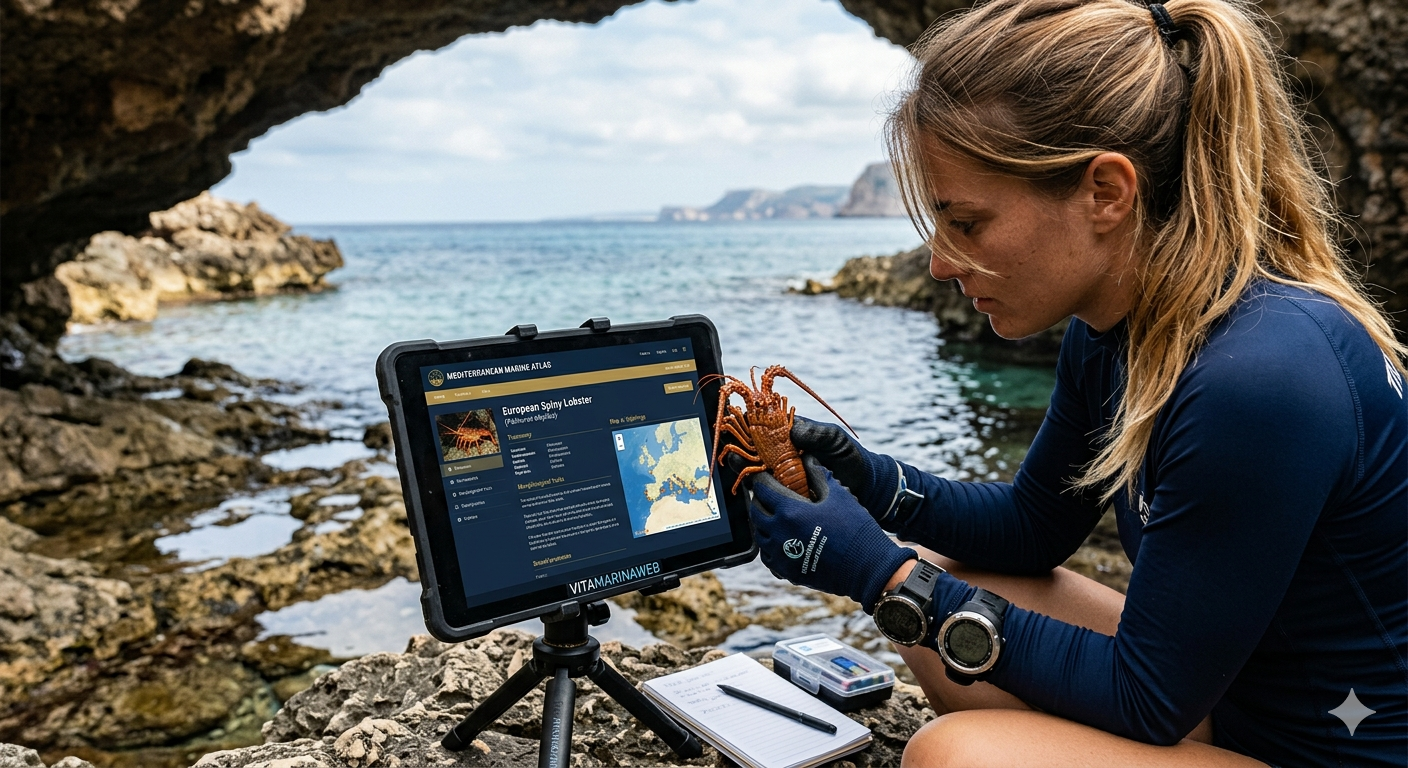 Field taxonomy in the Mediterranean: A marine biologist using the Vitamarinaweb digital atlas on a rugged tablet to classify a specimen of European Spiny Lobster (Palinurus elephas) during a coastal biodiversity survey